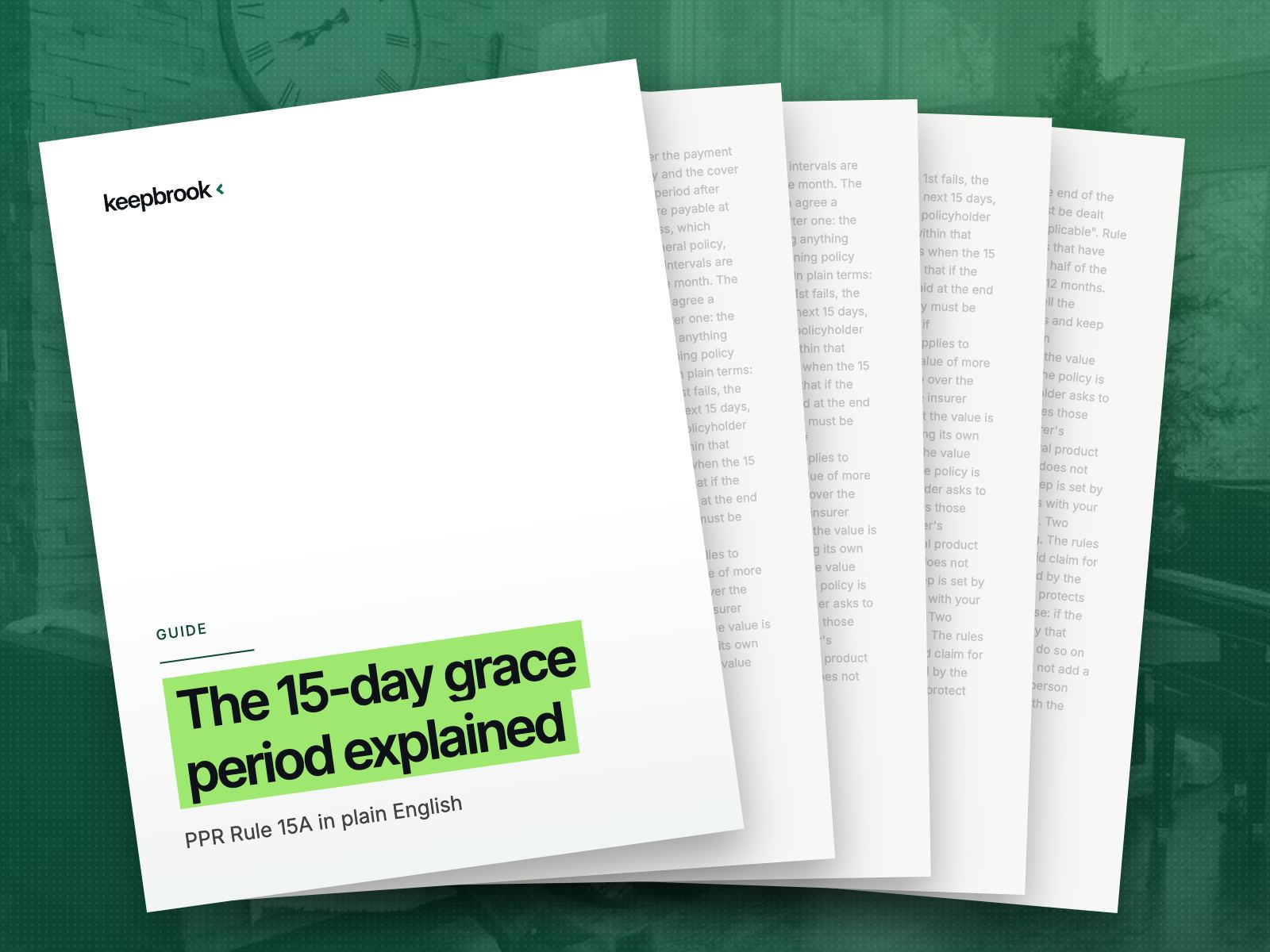
When a policyholder's debit order bounces, the policy does not end that day. South Africa's Policyholder Protection Rules for long-term insurance set a minimum window, called a grace period, in which cover stays in place and the premium can still be paid. For a funeral policy paid monthly, that window is 15 days.
Where the rule comes from
The Policyholder Protection Rules (Long-term Insurance), 2017, usually called the PPRs, were published in Government Notice 1407 of 15 December 2017. National Treasury and the then Financial Services Board announced that they would take effect from 1 January 2018, with transitional arrangements for some parts.
The grace period sits in Rule 15A, "Payment of premiums". It was not in the original 2017 text. It was inserted by an amendment, Government Notice 997 in Government Gazette 41928 of 28 September 2018, and applies from 1 October 2018. It took over from section 52 of the Long-term Insurance Act, which the Insurance Act of 2017 repealed.
What Rule 15A.1 requires
Rule 15A.1 applies when a premium on a long-term policy (other than a fund policy) is not paid on its due date. It does two things.
First, the insurer must notify the policyholder of the non-payment within 15 days after the payment was due.
Second, the policy and the cover must stay in force for a set period after the due date. If premiums are payable at intervals of one month or less, which covers a normal monthly funeral policy, that period is 15 days. If the intervals are longer than a month, it is one month. The insurer and policyholder can agree a longer period, but not a shorter one: the rule applies "notwithstanding anything therein to the contrary", meaning policy wording cannot cut it down.
In plain terms: if the debit order due on the 1st fails, the family is still covered for the next 15 days, and the insurer must tell the policyholder about the missed payment within that same window.
What happens when the 15 days run out
Rule 15A.2 says that if the overdue premium is still unpaid at the end of the grace period, the policy must be dealt with under Rule 15A.3, "if applicable".
Rule 15A.3 only applies to policies that have built up a value of more than half of the premiums due over the next 12 months. For those, the insurer must tell the policyholder what the value is and keep the policy going, using its own documented procedure, until the value runs out, premiums resume, the policy is made paid-up, or the policyholder asks to surrender it. Rule 15A.4 requires those procedures to satisfy the insurer's statutory actuary.
If your funeral product has no such value, Rule 15A.3 does not come into play, and the next step is set by your policy wording. Check this with your actuary and compliance officer.
Two related rules are worth knowing. The rules allow an insurer to reduce a valid claim for an event during the grace period by the unpaid premium. And Rule 2A.9 protects funeral policyholders after a lapse: if the insurer reinstates a funeral policy that lapsed for non-payment, it must do so on at least the same terms and may not add a new waiting period. If the same person takes out a new funeral policy with the insurer within two months of the lapse, no waiting period may be imposed either, except for any part of an original waiting period that had not yet been served.
What this means day to day
The grace period is short, so a failed collection should trigger the non-payment notice quickly, not on day 14. The policyholder needs to know three things: that the premium was missed, how much is owed, and how to pay before cover is at risk. Every day that passes before they hear about it is a day less to fix it.
Sources
- Policyholder Protection Rules (Long-term Insurance), 2017, Rule 15A: Payment of premiums. Acts Online (secondary consolidation of the gazetted text). acts.co.za. Accessed 2026-11-07.
- Tranche 2 amendment to the Long-term Insurance PPRs, September 2018 (tracked-changes version, includes Rules 2A.9, 15A, 17 and the commencement table). National Treasury. treasury.gov.za. Accessed 2026-11-07.
- Policyholder Protection Rules (Long-term Insurance), 2017, Rule 2A.9: Reinstatement. Acts Online (secondary). acts.co.za. Accessed 2026-11-07.
- Media statement: Release of final insurance conduct regulations and policyholder protection rules (15 December 2017). National Treasury and Financial Services Board. treasury.gov.za. Accessed 2026-11-07.
- Media statement: Joint publication of amendments to the Regulations and Policyholder Protection Rules (2 October 2018). National Treasury and Financial Sector Conduct Authority. treasury.gov.za. Accessed 2026-11-07.
- Notice regarding the publication of draft amendments to the Policyholder Protection Rules (Long-term Insurance) (30 July 2021; cites GN 1407 of 15 December 2017 and GN 997, GG 41928, 28 September 2018). Financial Sector Conduct Authority, hosted by Clyde & Co. cdn.clydeco.com. Accessed 2026-11-07.